





















Before the Pilot – Traditional Emergency Care Pathway
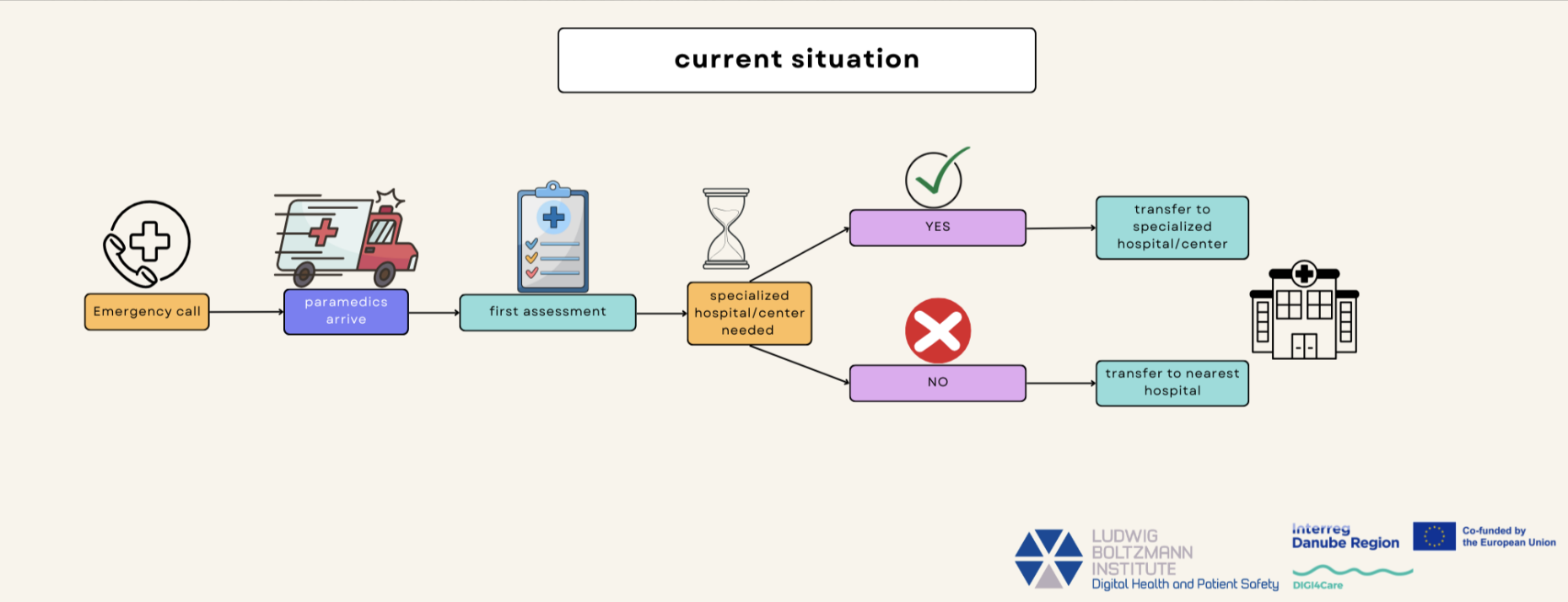
Patients requiring emergency medical services are assessed primarily through clinical examination, vital signs, and the experience of the responding emergency team. Although these methods are effective for many situations, some life-threatening conditions—such as internal bleeding, pneumothorax, cardiac tamponade, or severe cardiac dysfunction—cannot always be identified reliably without diagnostic imaging.
Portable ultrasound devices have become increasingly available, but widespread adoption in prehospital care has been limited by the difficulty of training enough emergency professionals. Conventional ultrasound education depends on face-to-face instruction by experienced experts, requiring significant travel, scheduling, and instructor availability. As a result, ultrasound competence varies considerably between regions and providers, creating inequalities in access to advanced prehospital diagnostics.
Consequently, emergency teams may rely on precautionary patient transfers, additional hospital investigations, or delayed diagnosis after hospital arrival, potentially increasing healthcare costs and prolonging time to definitive treatment.
After the Pilot – Digitally Enabled Integrated Emergency Care
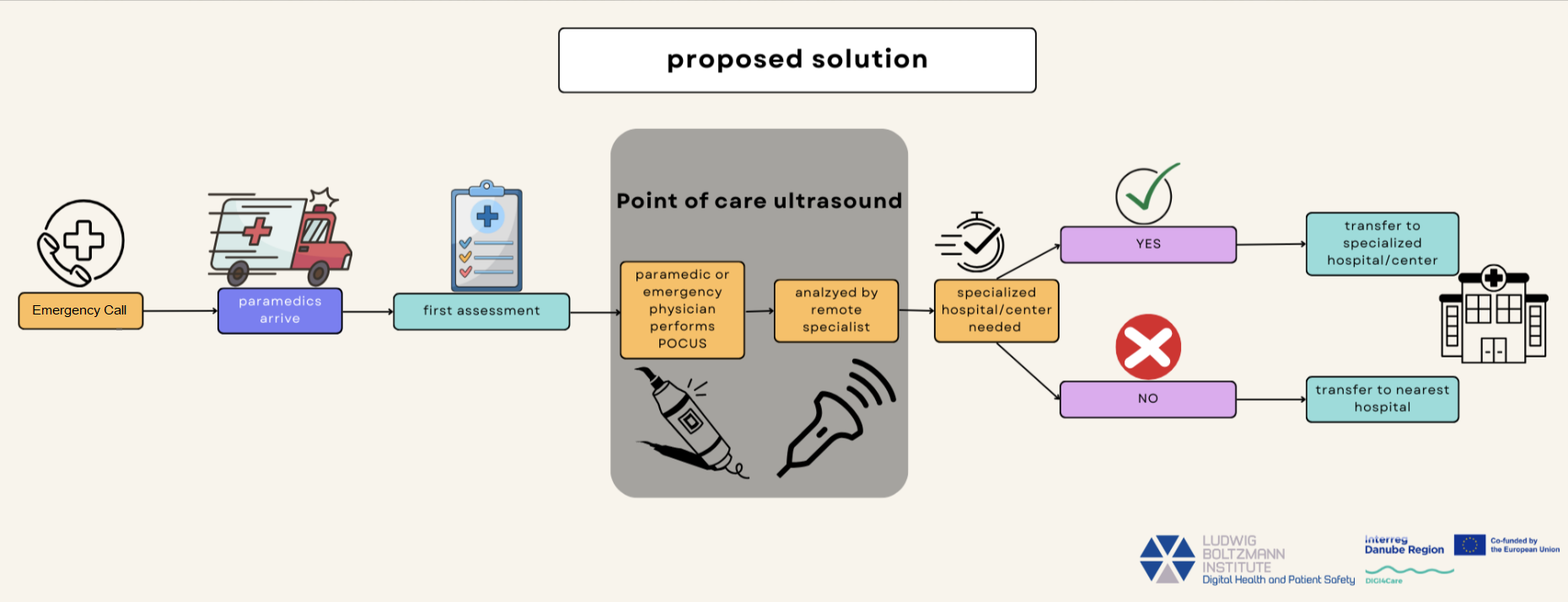
Pilot 2 introduces a digitally enabled training and support model that combines portable point-of-care ultrasound (POCUS), standardized e-learning, and real-time tele-supervision by expert clinicians. Instead of requiring the instructor to be physically present, emergency professionals can receive live guidance while performing ultrasound examinations through secure audiovisual communication.
The integrated care pathway begins with standardized online education, followed by practical hands-on training using telemedicine technology. During both training and, where regulations permit, clinical use, expert supervisors can observe the same ultrasound images in real time, guide probe positioning, support image interpretation, and provide immediate feedback.
This approach enables more emergency professionals to acquire high-quality ultrasound skills without increasing the number of instructors, improving access to advanced diagnostics across urban and rural regions alike. Earlier identification of critical conditions supports more accurate triage, more appropriate destination hospital selection, earlier activation of specialist teams, and better coordination between prehospital and hospital care.
The pilot also establishes a structured digital ecosystem for competency assessment, secure data management, and continuous quality improvement. Training performance is evaluated using validated assessment tools, while examination recordings and educational data support ongoing professional development and future service planning.
Overall, the integrated care model transforms emergency ultrasound training from a resource-intensive, location-dependent process into a scalable digital learning system that strengthens collaboration between emergency medical services, specialist clinicians, hospitals, and educational institutions, ultimately improving the continuity and quality of emergency care.